Section
Headphones & Monitors
Two pieces of audio gear sit between every working drummer and a ruined inner ear. We cover both.
Isolation headphones, in-ear monitors, and the explainer content that helps you choose between them. Every guide is rebuilt every 90 days.
- 5 articles
- 3 products reviewed
- −25 dB isolation pick
Trending · Buyer's guide
Best Isolation Headphones for Drummers
The studio standard from Vic Firth, plus a $25 budget pick and the mixing-room workhorse. Three picks, fully reviewed.
Read the guide →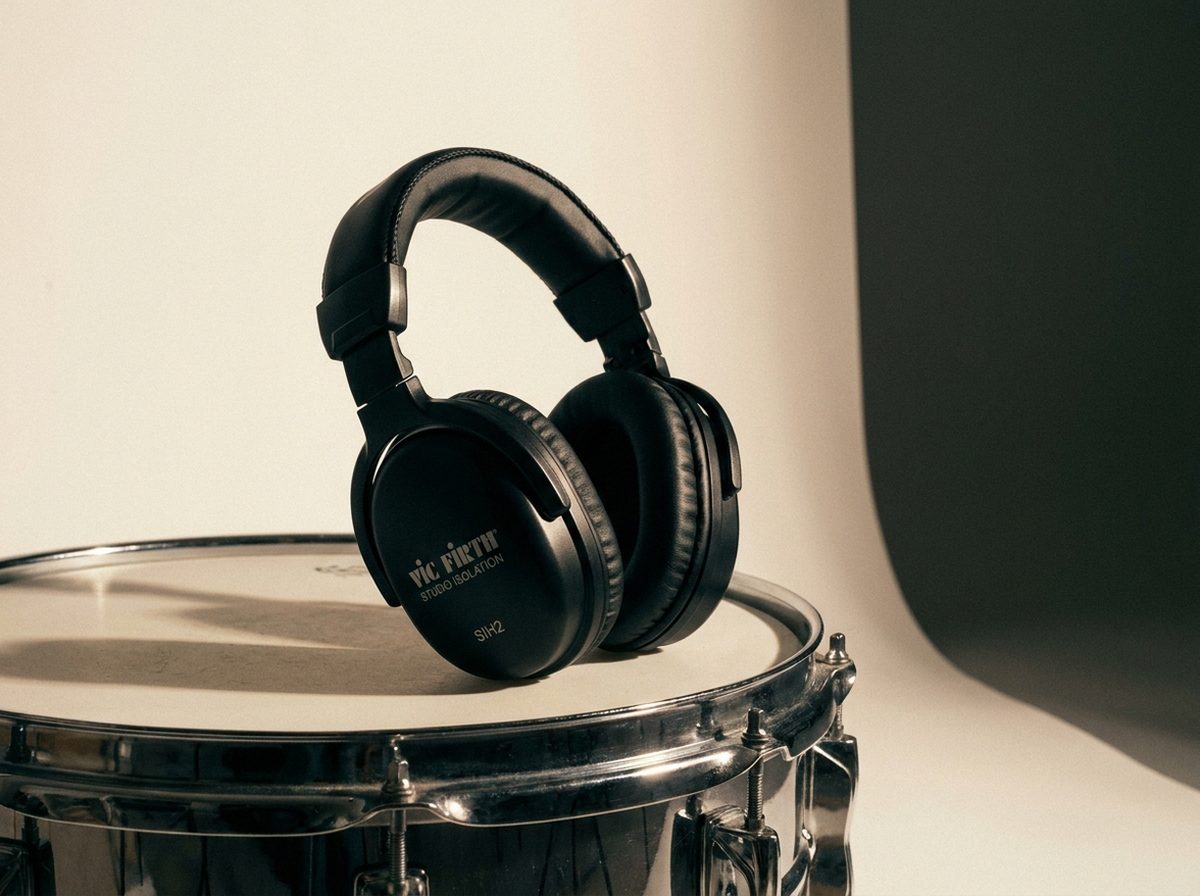
More from this section
Every article in this section
Buyer's guide
Best In-Ear Monitors for Drummers
Live monitoring without the eardrum damage. Five IEMs ranked, plus the difference between 'audiophile' and 'drummer' models.
Read →Comparison
In-Ear Monitors vs Isolation Headphones
When to wear which, what each does to your hearing, and which one fits your gigging or studio context.
Read →Explainer
Why Do Drummers Wear Headphones?
Hearing protection, click tracks, and the studio reasons every working drummer monitors what they're playing.
Read →Buyer's guide
Best Ear Protection for Drummers
Three musician's earplugs ranked. Etymotic, Eargasm, and a custom-mold option for difficult ear shapes.
Read →The basics
What are drum headphones, and which kind do you need?
“Drum headphones” isn’t a marketing category — it’s a working term for any headphones engineered to handle the unique acoustic problem drummers face: how to monitor an audio signal (a click, a backing track, a band mix) over a 110+ dB drum kit sitting six inches from your head. Standard consumer headphones can’t solve this problem, no matter how premium they are. Open-back audiophile cans provide essentially zero isolation. Closed-back consumer headphones (AirPods Max, Sony WH-1000XM5) attenuate at most 18 dB, which isn’t enough for an aggressive kit. Active noise-cancelling can’t cancel cymbal frequencies and adds latency that throws off click timing.
Two categories of purpose-built drumming headphones solve the problem. Passive isolation headphones use sealed over-ear earcups to physically block 20-32 dB of kit volume — the standard for studio tracking, home practice, and electronic-kit monitoring. In-ear monitors use foam or silicone tips for an in-ear-canal seal that achieves similar isolation in a much smaller form factor — the standard for live touring with click tracks and personalised stage mixes. Most working drummers eventually own both because the situations they’re built for are genuinely different.
Underneath both categories sits a third concern: hearing protection. Even with a well-fitted pair of isolation headphones or IEMs, drummers playing acoustic kits at rehearsal or stage volume are routinely above OSHA’s safe-exposure threshold for the cumulative time they spend behind the kit. Musician’s earplugs (Etymotic ER20XS, Eargasm Hi-Fi) are the third piece of the puzzle — worn alone in non-monitoring contexts (rehearsal without a click, live work with stage wedges) or layered under monitor-mixed IEMs for extra attenuation. The articles below cover all three categories.
By use case
Studio, stage, practice, hearing protection — pick the gear by where you play
Studio tracking and home practice are the two most common use cases, and for both the answer is the same: closed-back passive-isolation over-ear headphones. The Vic Firth SIH2 is the working studio standard at $89; the Sony MDR-7506 is the studio mixing favourite for playback. Both attenuate 25–30 dB without electronics, which means zero latency — critical when monitoring a click track. See our best headphones for drummers guide for the full ranking.
Live touring and stage monitoring almost always means in-ear monitors with a beltpack receiver and a personalised mix from FOH. The Shure SE215 is the entry-level touring standard ($99); the Westone AM Pro X20 adds ambient passthrough so you can hear the crowd; the Shure SE846 is the studio-grade premium pick. See our best in-ear monitors guide for the decision tree, and the IEMs vs headphones head-to-head if you’re torn between the two formats.
Hearing protection is the third, non-negotiable piece. Even with monitoring headphones or IEMs in, drumming on an acoustic kit at rehearsal or stage volume routinely exceeds 100 dB and causes irreversible high-frequency hearing loss over time. Musician’s earplugs — flat-attenuation, not foam — are the cheapest insurance most drummers will ever buy. See best ear protection for drummers for the three picks every gigging drummer should know.
Frequently asked